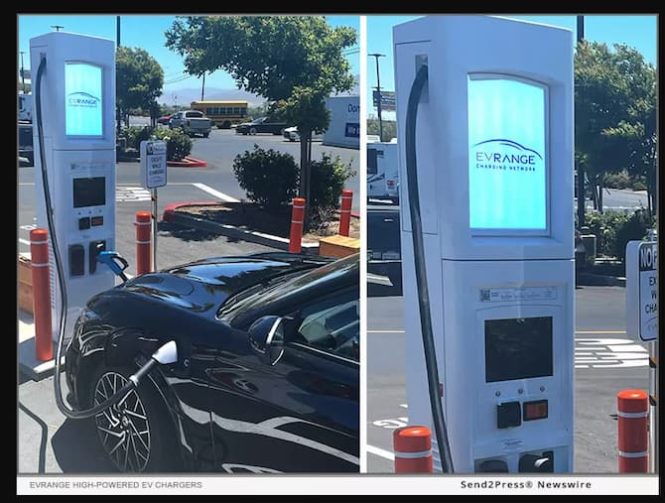
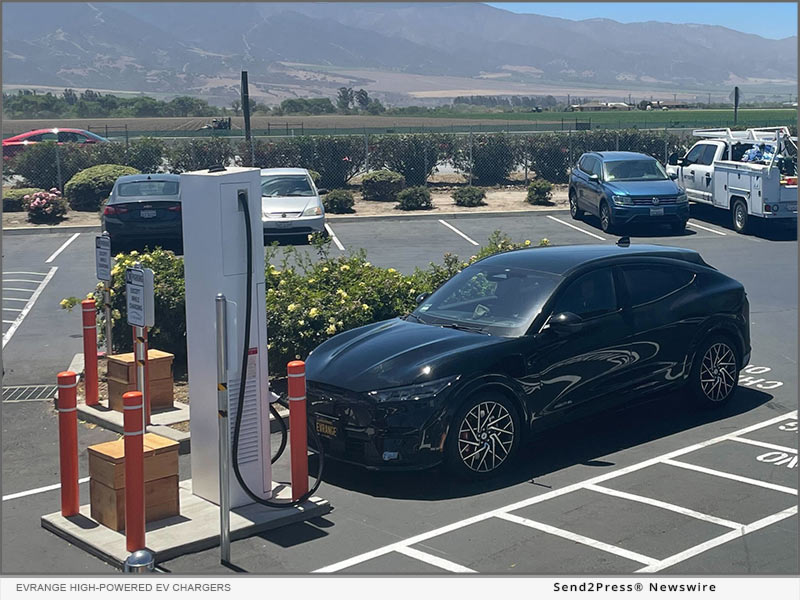
EV Range, Inc. announced the launch of new fast chargers for electric vehicles in Soledad, California. PR by EV Range
SOLEDAD, Calif., June 21, 2022 (SEND2PRESS NEWSWIRE) — EV Range, Inc., the leader in zero emission vehicle charging station management software solutions and installation services today announced the launch of new fast chargers for electric vehicles in Soledad, California. The EV market is quickly moving from early adopters to the mass market with EVs becoming a person’s primary and only vehicle. Although many people can charge their cars at home or near their workplace, range anxiety is a significant issue when driving beyond those areas. This becomes particularly acute during long range travel and in rural corridors.
ev chargers california
“We are really excited to bring these chargers to Highway 101 drivers,” said Carl Pancutt, CEO of EV Range. “Unlike the majority of currently available chargers in California, the chargers in Soledad can deliver up to 200 miles in just 15 minutes, which is the sweet spot for those driving through highway corridors. In addition, our driver app implements a frictionless payment methodology and our backend charger management system monitors the chargers in real time to immediately address uptime issues.”
“Our property has many shops and restaurants that attract travelers through Central California. Installing fast chargers allows us to add a new and necessary amenity for EV drivers,” said Beau Oxsen of Shaw Development. “In addition, we are able to further monetize our unique location and bring more people to our tenants’ establishments. Everyone wins.”
The process to bring these future-proof chargers online was done in conjunction with Monterey Bay Air Resources District which was instrumental in helping fund this state-of-the-art charging location.
“MBARD’s objective is to improve air quality across Monterey, Santa Cruz, and San Benito Counties,” said David Frisbey, Planning and Air Monitoring Manager of the Monterey Bay Air Resources District. “We are in a new world of opportunities to mitigate the environmental impacts from cars and trucks. Working with companies like EV Range, and highway corridor property owners, enables us to ensure that EVs can travel easily through the North Central Coast Air Basin.”
About EV Range:
EV Range is a full-service, vertically integrated electric vehicle infrastructure solution provider. Our software and services are available to consumers and businesses. To learn more about EV Range visit https://www.evrange.com/
Tesla megadeal with Samsung for self-driving cameras. From IoT World Today
Excerpt:
The agreement with the Electro-Mechanics arm of Samsung is believed to be worth in the region of $3.2 billion to $4 billion. It was first reported by the Korea Economic Daily – an outlet that has broken the news of previous partnerships between the pair – and will make Samsung the largest supplier of camera modules to Tesla.
Although neither Samsung nor Tesla has commented on the deal, it is understood that the camera modules will be used across the entire line-up, being installed on the Model 3, Model S, Model X and Model Y, as well as the Cybertruck when that finally arrives and also the forthcoming Semi Class 8 truck.
In contrast to many automakers who use radar and Lidar to deliver assisted driving functionality, Tesla has relied on cameras to provide imagery for its neural networks. The current version of Autopilot features eight cameras that have a rumored resolution of around 1.2 million pixels.
In other news — Tesla cars are banned from Chinese town over spying fear – LINK – The concerns appeared to be related to Tesla’s use of cameras all around its vehicles and where the data is going.
A northern California lithium-ion battery company has devised an electric vehicle (EV) battery that reaches a full charge in just over ten minutes. From ExtremeTech
In Brief
Silicon Anode (current iteration is graphite anodes)
Batteries to last 10 years
Excerpt
Enovix’s specialty is a silicon-anode lithium-ion battery it calls 3D Silicon. The name refers to a proprietary 3D architecture and constraint system, as well as the cells’ 100 percent active silicon anode. Enovix has previously used this technology to create batteries for smartphones, laptops, smart watches, and mobile radios. Its latest development, however, is a super fast-charging EV battery that will put even the Lucid Air to shame.
The company has demonstrated its 0.27 Ah test cells to be capable of charging from 0 to 80 percent “in as little as 5.2 minutes,” according to a press release. They’re able to reach 98 percent capacity within 10 minutes. Enovix conducted the tests as part of a three-year Department of Energy grant program challenging the company to create high-capacity, fast-charging EV batteries—an achievement it seems so far to have met. Even after 1,000 charge cycles (some under particularly high temperatures), the 3D Silicon batteries retained 93 percent of their capacity. Enovix therefore estimates its batteries will last at least 10 years.
The Pennsylvania Department of Transportation is asking for public feedback as it puts together a plan to build more infrastructure in the state for electric vehicles.
The program will allow for charging stations that would provide up to an 80% charge to a vehicle in about 30 minutes. It’s called the National Electric Vehicle Program and it was created through the bipartisan infrastructure law passed by Congress.
PennDOT officials say as part of the law, they will receive and distribute millions of dollars toward EV charging infrastructure over the next five years. PennDOT says the plan is an evolving document that can be updated annually to new initiatives and areas of focus.
“PennDOT is committed to making future-focused investments in Pennsylvania to update our highway network to accommodate more electric vehicles and hybrids,” PennDOT secretary Yassmin Gramian said.
If you want to submit your feedback on the plan, you can do that online here. The deadline for public comment is June 30.
Keywords
“nevi survey”,
“nevi”,
“national electric vehicle infrastructure”,
“national electric vehicle program”,
“pa charging stations”,
“Pennsylvania electric vehicle recharging stations”,
“pa ev infrastruction”,
“electric vehicle infrastructure in Pennsylvania”,
“more charging stations in Pennsylvania”,
“public feedback on pa ev plan”,
“Pennsylvania plan for electric vehicles”,
“penndot ev plan”,
“electric vehicles”,
“Pennsylvania Department of Transportation”,
“penndot”
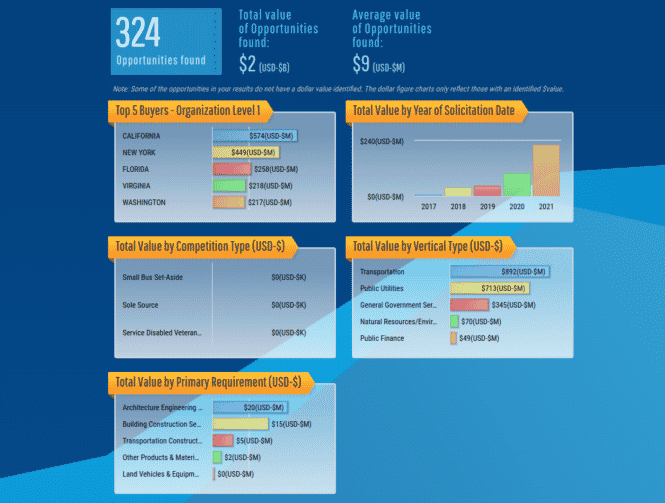
We track the RFPs issued in this space and have seen a remarkable increase in bids and budgets. The truly remarkable item here is that opportunities for EV charging and vehicles isn’t only in the SLED and FED space, it is in the consumer space. If you are putting in that custom hardwood floor in your luxury cabin in Aspen, odds are you will opt for nice EV charger as well.
June 2022 Snapshot EV Charging Market
Click for full size — EV Charging MarketA look at year by year, as of June 17th, 2022
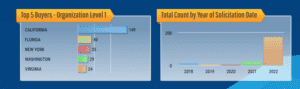
click for full size – EV Charging Market by Year
Here are top 100
NEW YORK STATE DEPARTMENTS
BAY AREA AIR QUALITY MANAGEMENT DISTRICT
HALLANDALE BEACH, CITY OF (BROWARD)
NEW YORK STATE DEPARTMENTS
MUKILTEO SCHOOL DISTRICT 6
SAN MATEO, COUNTY OF
UNIVERSITY PARK, CITY OF (DALLAS)
MARIN, COUNTY OF
BEXAR, COUNTY OF
SAN DIEGO, CITY OF (SAN DIEGO)
HILLSBOROUGH COUNTY SCHOOL DISTRICT
WASHINGTON STATE JOINT TRANSPORTATION COMMITTEE
SPOKANE AIRPORT BOARD
FILLMORE UNIFIED SCH DIST
CALIFORNIA STATE DEPARTMENTS
SACRAMENTO, CITY OF (SACRAMENTO)
PALM DESERT, CITY OF (RIVERSIDE)
BAY HARBOR ISLANDS, TOWN OF (MIAMI-DADE)
FLORIDA STATE DEPARTMENTS
SPOKANE, CITY OF (SPOKANE)
BALTIMORE, CITY OF (BALTIMORE CITY)
GILROY, CITY OF (SANTA CLARA)
SAN FRANCISCO, CITY AND COUNTY OF (SAN FRANCISCO)
SACRAMENTO, CITY OF (SACRAMENTO)
ULSTER, COUNTY OF
FISHERSVILLE, CITY OF
NEW YORK STATE DEPARTMENTS
KYLE, CITY OF (HAYS)
BALTIMORE, CITY OF (BALTIMORE CITY)
SAN LUIS OBISPO, CITY OF (SAN LUIS OBISPO)
COVINA, CITY OF (LOS ANGELES)
NEW YORK STATE DEPARTMENTS
HALLANDALE BEACH, CITY OF (BROWARD)
HALLANDALE BEACH, CITY OF (BROWARD)
SACRAMENTO, CITY OF (SACRAMENTO)
WASHINGTON STATE JOINT TRANSPORTATION COMMITTEE
NASSAU, COUNTY OF
CARY, TOWN OF (WAKE)
OCEANSIDE, CITY OF (SAN DIEGO)
SANTA CLARA, CITY OF (SANTA CLARA)
AUSTIN COMMUNITY COLLEGE DISTRICT
LACEY, CITY OF (THURSTON)
LOS ANGELES COUNTY METRO TRANSIT AUTHORITY
NORTH CAROLINA STATE DEPARTMENTS
ROSEVILLE, CITY OF (PLACER)
NASSAU, COUNTY OF
NEW YORK STATE DEPARTMENTS
WASHINGTON STATE JOINT TRANSPORTATION COMMITTEE
ROCHESTER GENESEE REGIONAL TRANSPORTATION AUTHORITY
REDDING, CITY OF (SHASTA)
LOS ANGELES COUNTY METRO TRANSIT AUTHORITY
OAKLAND, CITY OF (ALAMEDA)
NEW YORK STATE DEPARTMENTS
NEW YORK, CITY OF (NEW YORK)
EAGLE, TOWN OF (EAGLE)
ARLINGTON, COUNTY OF
CHAMBLEE, CITY OF (DEKALB)
OAKLAND, CITY OF (ALAMEDA)
EASTSIDE UNION HIGH SCHOOL DIST
LIVERMORE, CITY OF (ALAMEDA)
CALIFORNIA STATE DEPARTMENTS
NEW YORK, CITY OF (NEW YORK)
NEW YORK STATE DEPARTMENTS
CALIFORNIA STATE DEPARTMENTS
CALIFORNIA STATE DEPARTMENTS
SAN MATEO, COUNTY OF
REDWOOD, CITY OF (SAN MATEO)
MECKLENBURG, COUNTY OF
SANTA ANA, CITY OF (ORANGE)
WACO, CITY OF (MCLENNAN)
WACO, CITY OF (MCLENNAN)
SNOHOMISH COUNTY PUBLIC UTILITY DISTRICT 1
MARYLAND STATE DEPARTMENTS
LIVERMORE, CITY OF (ALAMEDA)
CALIFORNIA STATE UNIVERSITY-SAN MARCOS
SACRAMENTO, CITY OF (SACRAMENTO)
COLORADO STATE DEPARTMENTS
PORT ANGELES, CITY OF (CLALLAM)
DUBLIN, CITY OF (ALAMEDA)
DUBLIN, CITY OF (ALAMEDA)
GEORGIA STATE DEPARTMENTS
ARVIN, CITY OF (KERN)
MARIPOSA, COUNTY OF
ARLINGTON, COUNTY OF
SACRAMENTO, CITY OF (SACRAMENTO)
EVERETT, CITY OF (SNOHOMISH)
FAYETTEVILLE, CITY OF (CUMBERLAND)
COVINA, CITY OF (LOS ANGELES)
LOS ANGELES, CITY OF (LOS ANGELES)
NEW YORK STATE DEPARTMENTS
FRESNO, COUNTY OF
FULLERTON ELEM SCH DIST
Samsung EV Charging Stations from IoTecha & Samsung
Not surprising to see Samsung hooking up with Iotecha for EV charging stations. And several Samsung partners have signed up as well.
Synopsis – What you need to know
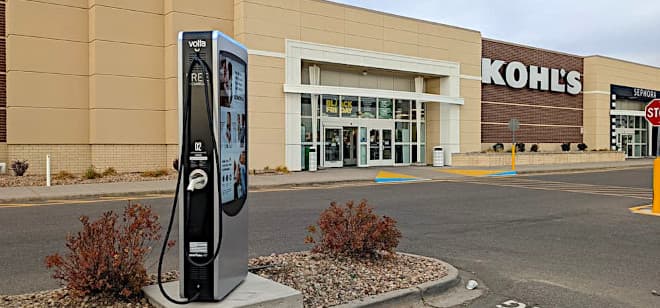
Big market for large format outdoor displays and Samsung. You can see dual sided 55s being used in Volta/Peerless-AV.
IoTecha’s Level 2 AC Charger is the most advanced level 2 EVSE on the market. This EVSE provides up to 19.2kW of charging power at 80A. It supports ISO 15118 High-Level Communications with the EV as well as OCPP 1.6+ to implement both Plug and Charge and Smart Charging over a variety of connectivity options (LAN, Wi-Fi, LTE, etc). This charger has an extensive track record of successful interoperability with many electric vehicle manufacturers and charge point operators.
Level 2 charging typically uses 240v power and (typically) around 16 to 30 Amps to get the job done. With this method, a Tesla Model 3 can be charged from empty to full in 6 to 8 hours. The time variation reflects differences between chargers and the electrical interfaces that can be used for Level 2 chargers. To use Level 2 charging at home, you will have to spend some money! This can vary from a modest outlay (say, $200) to significantly more (say, $2000), depending on the type of charger you decide to purchase. The two key types of Level 2 chargers are ‘hardwired’ and ‘plug-in’.
Someone like Electrify America starts at 150kW (ultra fast DC) and now offers 350 kW Hyper Charging.
Hyper is 20 miles per minute of charging (350 kw). Ultra is 9 miles a minute (150 kW).
By contrast Iotecha is 1.2 miles per minute of charging
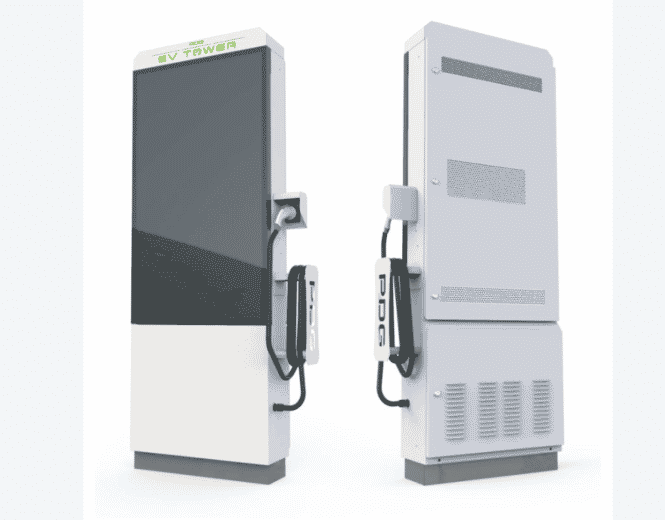
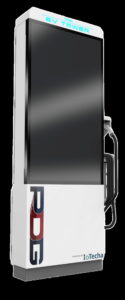
Samsung Electronics Co., Ltd. and IoTecha Corp. announce a strategic collaboration to introduce a new range of electric vehicle charging stations that combine Samsung’s best-of-breed display and signage solutions with IoTecha’s industry-leading EV charging technology. The resulting platform is expected to open up new driver and customer experiences for a wide range of commercial customers, including retail and hospitality, and enable innovative business models and revenue streams for digital signage and EV charging network providers.
Samsung and IoTecha have created a comprehensive EV charging kiosk solution featuring Samsung’s OH series touch screens and IoTecha’s Level 2 charging components. The integration of hardware and software addresses key challenges affecting deployment of both EV charging and digital signage infrastructure, from cost and complexity of equipment, installation, and operation, to remote monitoring, management, and maintenance.
Click for full size – Samsung iotecha ev charging stations
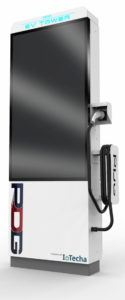
Click for full size image – Samsung iotecha ev charging stations
“We believe that together, Samsung and IoTecha provide a cost-effective platform delivering fast and smart EV charging service and integrated in kiosks that bring visually dynamic interfaces with services, including Iotecha’s IoT.ON™ and Samsung’s MagicInfo with programmatic advertising,” said Kim Sarubbi, VP of Media at IoTecha Corp., and speaker at the upcoming Samsung VX event. “IoTecha’s proven track record, built on standards with proven capabilities, combined with Samsung’s technologies, is believed to be the solution infrastructure providers and end customers need to accelerate their electrification goals and differentiate their charging and digital signage offer as EV adoption accelerates.”
IoTecha provides hardware, software and cloud services for turnkey installation of a fully customizable EV charging infrastructure. IoTecha’s level 2 chargers deliver fast charging (up to 19.2kW at 80A), offer versatile and reliable networking options, and implement standard-based and interoperable high-level communications. Built-in support for IEC/ISO 15118 and OCPP 1.6 enables advanced driver experiences and innovative services such as Plug and Charge, Smart Charging and bi-directional power flow. Native connectivity to IoTecha’s IoT.ON™ Cloud and Edge services allows customers to reduce the total cost of ownership of their charging infrastructure. Installations can be remotely monitored, configured, and updated resulting in reduced maintenance costs and improved customer service. IoTecha’s topology-aware energy management allows the creation of highly customized optimization algorithms to meet the operational needs of site hosts and facility managers while minimizing electricity costs.
“We believe that Samsung and IoTecha’s business models and technologies combine perfectly to rapidly bring to market a brand new, visual, engaging and optimized EV charging experience,” said Chris Mertens, Vice President of US Sales, Samsung Display Division. “Samsung and IoTecha are looking forward to delivering highly customized services and content that meet and exceed customer requirements and unlocking new revenue streams for both site hosts and service providers.”
Complete kiosks can be highly customizable for white-label branding to match retail, hospitality, business, and other commercial area deployments that feature printed decals or wraps. Each unit supports Plug and Charging services and interactive displays for programmatic advertising, customer information, service offers, personalized messages, and more.
Samsung
Units can be fitted with Samsung’s OH series ultra-thin 1080p (Full HD) 1920 x 1080 display screens for reliable performance in any environment. UL-verified Magic Protection Glass screens offer LED-backlit LCD display that are IK10-rated against impact and IP56-rated for extreme weather exposure. Anti-glare technology and brightness levels greater than 3,500nits provide crisp visibility with sensor-driven automated brightness reduction for efficiency. An integrated power box and four internal fans assure optimized electronics performance, supported by Samsung’s MagicINFO Player S6 and TIZEN operating system can be embedded for optimized display performance and accurate content management. For more information, please visit https://www.samsung.com/us/business/displays.
IoTecha
IoTecha’s IoT.ON™ platform aims to accelerate the electric vehicle revolution by providing an integrated platform consisting of software, hardware and cloud components for the smart charging infrastructure and power grid integration of electric vehicles of all kinds. IoTecha customers are energy and power companies, charge point operators, and manufacturers of both Electric Vehicles and EV charging stations. IoTecha products include V2G and HomePlug Protocol Analyzer, Combined Charging System on Module (and custom modules), EV charging stations and IoT.ON™ Cloud-based services. For more information, please visit https://www.iotecha.com.
FORWARD-LOOKING STATEMENTS
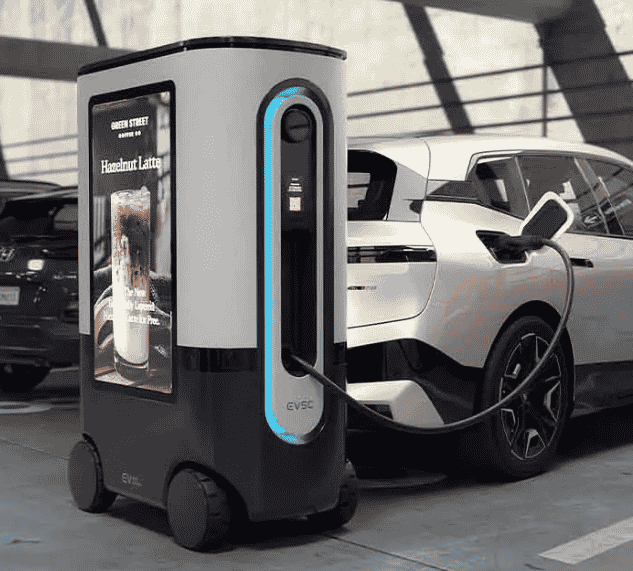
Introducing ZiGGY: An autonomous robot that saves you a parking spot then charges your EV
Charging technology provider EV Safe Charge has unveiled ZiGGY – a mobile robot that can charge an EV wherever it’s parked. Through its ability to recharge itself via different energy sources and its summoning feature, ZiGGY can alleviate the need to install specific parking stalls for EV charging, as any spot can now become a spot to recharge.
EV Safe Charge currently provides end-to-end charging solutions, particularly as it pertains to mobile charging. The company created a mobile rental charging solution for the launch of Jaguar’s I-PACE EV and works with several other OEMs like Audi, Mercedes-Benz, Nissan, Porsche, and Stellantis.
Previously, EV Safe Charge has helped find its clients ideal charging solutions based on their needs, recommending charging technology from a multitude of partners including ABB, Enel X, evconnect, and Bosch.
Now, EV Safe Charge has invented its own mobile charging device in the form of a robot named ZiGGY.
Calling All Stakeholders: ANSI to Develop Roadmap of Standards and Codes for Electric Vehicles at Scale
New York, June 8, 2022: The American National Standards Institute (ANSI) announced today the launch of an initiative to develop a roadmap of standards and codes for electric vehicles (EVs) at scale. The ANSI Electric Vehicles Standards Panel (EVSP) will serve as the forum for development of the document.
The priorities of the codes and standards effort will be to identify the most critical standards for EVs at scale, including for standards to address high-power DC charging, storage (i.e., microgrid, distributed energy resource management systems) integrated with DC charging, vehicle grid integration, high-power scalable/interoperable wireless charging, and vehicle-oriented systems. Subject-matter experts interested in participating are invited to review the panel architecture and sign upfor one or more working groups. A one-hour virtual kick-off event providing more details will be held June 15, 2022, at 12 noon Eastern. Register here. It is envisioned that the working groups will hold virtual meetings, twice per month, over the course of the coming year. A draft roadmap is targeted for mid-February 2023, which will then undergo public review before being finalized by mid-May 2023. Participation is open to EV stakeholders that have operations in the United States.
The ANSI EVSP is a cross-sector coordinating body whose objective is to foster coordination and collaboration on standardization matters among public- and private-sector stakeholders to enable the safe, mass deployment of electric vehicles and associated infrastructure in the United States with international coordination, adaptability, and engagement. Outputs of the EVSP in the 2011-2014 timeframe included a Standardization Roadmap for Electric Vehicles (Version 2.0, May 2013), a Progress Report (November 2014) against same, and a Standards Compendium. Though the priorities have shifted in many respects with the new focus on EVs@Scale, aspects of the earlier EVSP work may be drawn upon as needed.
ANSI’s facilitation of this initiative is supported in part by VTO/Argonne National Laboratory. Additional, exclusive sponsorship opportunities with appropriate recognition benefits are invited from industry and other directly affected stakeholders to help offset ANSI’s costs of operating the EVSP.
“ANSI is pleased to once again offer its services as a neutral facilitator and bring together interested stakeholders to identify the latest standards and conformance needs and challenges associated with the deployment of electric vehicles,” said S. Joe Bhatia, ANSI president and CEO.
The American National Standards Institute (ANSI) is a private non-profit organization whose mission is to enhance both the global competitiveness of U.S. business and the U.S. quality of life by promoting and facilitating voluntary consensus standards and conformity assessment systems, and safeguarding their integrity. Its membership is comprised of businesses, professional societies and trade associations, standards developers, government agencies, and consumer and labor organizations.
The Institute represents and serves the diverse interests of more than 270,000 companies and organizations and 30 million professionals worldwide. ANSI is the official U.S. representative to the International Organization for Standardization (ISO) and, via the U.S. National Committee, the International Electrotechnical Commission (IEC). For more information, visit www.ansi.org.
KioWare now part of the group which will help develop guidance for EV Charging Infrastructure
January 4, 2022
Stephanie Pollack, Deputy Administrator
Federal Highway Administration (FHWA)
RE: Development of Guidance for Electric Vehicle Charging Infrastructure
Deployment (Docket No. FHWA-2021-0022)
Dear Deputy Administrator Pollack,
Introduction
Analytical Design Solutions, Inc., DBA KioWare, appreciates the opportunity to comment on the Request for Information (RFI) to develop guidance for EV charging infrastructure
. As the Department proceeds in developing its guidance, we recommend that you take steps to ensure that publicly-accessible Electric Vehicle
Supply Equipment (EVSE) be: 1) secure, 2) accessible to all Americans (including the disabled), and 3) designed to deliver the maximum utility possible to both users and deployers. Our input is based on nearly two decades worth of experience helping the self-service kiosk industry deliver both secure and accessible kiosks2
.
The Challenge
Because publicly-accessible EVSE are typically unattended, they share many requirements of traditional self-service kiosks. Self-service kiosks are unique in that they are generally exposed to the public without the deployer of the kiosk being directly involved (or nearby). Additionally, they are often deployed in non-secured locations and exposed to a variety of weather conditions. Generally speaking, the kiosk needs to be able to function on its own.
FHWA’s standards (once final) will need to be met by states applying to receive federal funding for EV charger deployment (funding authorized by the infrastructure bill that passed late last year).
Comments on the notice of proposed rulemaking will be due 60 days following publication in the Federal Register.
Odds are the standards won’t be finalized until end of year. This means that funding for year 1 of the program will be issued without standards in place (think wild west). Mind you, CA already has EV charger standards in effect (which address things like payment, security, interoperability, etc.).
From MotorVehicleRegs (highly recommended source to subscribe to)
On June 9, 2022, FHWA announced a Notice of Proposed Rulemaking (NPRM) for proposed minimum standards and requirements for projects funded under the National Electric Vehicle Infrastructure (NEVI) Formula Program and projects for the construction of publicly accessible electric vehicle chargers funded under title 23, United States Code. FHWA also released additional resources to help states successfully complete their deployment plans and access NEVI Formula Program funding to build out a national network of electric vehicle chargers. These resources include new NEVI Formula Program Questions and Answers and an exception template to help states, particularly rural states, evaluate the best locations for charging stations when it may not be possible to provide charging stations at the required 50-mile intervals.
The deadline for comments will be 60 days following publication in the Federal Register.