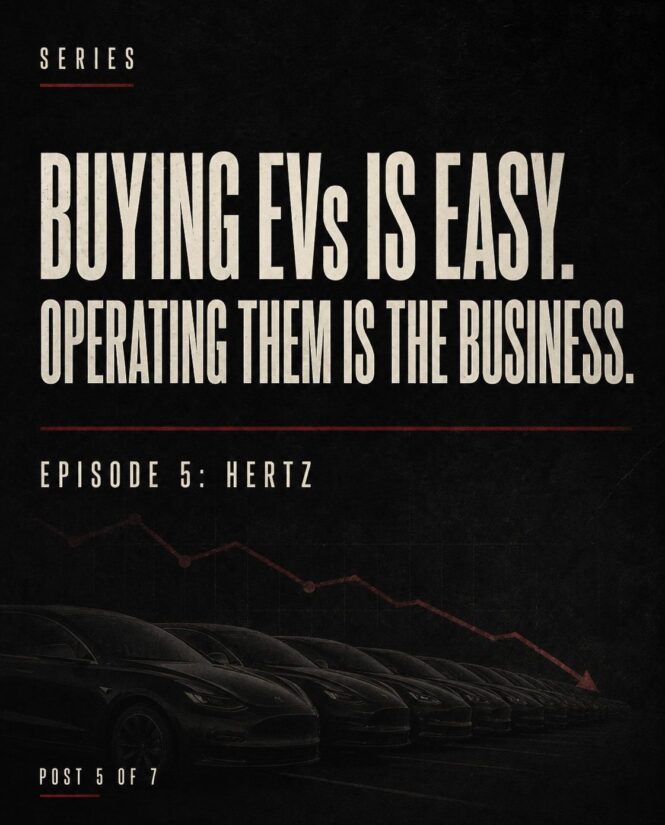
Hertz bought 100,000 Teslas for 4.2 billion dollars

Energy Infrastructure Commercial Leader & Patented Innovator | BESS · Data Center Power · Behind-the-Meter · Microgrids | 0 to 1 Builder Across EV Charging & Fleet Electrification | P&L Leadership
Post on LinkedIn by Angelo — Three years later it had lost roughly 2.9 billion on its electric bet and was dumping the cars on the used market, some Model 3s going for under 20,000 dollars. The money is only half the story. The plan itself was broken from day one. This is part five of my series on the biggest EV failures of the last decade, and it sits closest to the work I do.
Start with charging. Hertz made a corporate decision not to install chargers at its own locations. Staff at some big airports had to drive the cars off site to public fast chargers to refill them, like taking a gas car somewhere to fuel up, only far slower. So cars went out at 40 or 50 percent charge because the lot could not turn them around in time.
Then the customer side. Hertz handed first time EV drivers a car they had never used, with little guidance on how or where to charge it, and expected them to sort it out while racing to catch a flight. The counter staff were not trained either. People arrived to find the only cars left were EVs they had not asked for, with no charging map, plugs that did not fit nearby stations, and a screen they could not read.
The billing made it worse. After years of training renters to bring cars back low to collect refueling fees, Hertz slapped a flat charge on any EV returned under 70 percent. Some were even billed for gasoline an EV cannot burn. One Model 3 came back at the same charge it left with and still drew a 277 dollar gas fee, blamed on a systems error.
All of that killed demand. To move the cars, Hertz priced EVs at half the cost of a gas rental, which deepened the hole. Tesla then cut its prices again and again, dragging down the resale value of every Tesla Hertz owned, and the fleet was depreciating at around 592 dollars a month. Hertz took a 245 million dollar charge on the first batch it sold, dropped its 25 percent electric target, and lost its CEO by early 2024. The damage even reached leasing firms in Germany and the UK.
Here is the part that matters, and it has nothing to do with electric cars being bad. Hertz tried to swap gas cars for EVs and run the business exactly as before. A fleet does not work that way. It lives or dies on residual value, repair cost, total cost of ownership, and a model built for the product you bought. Get the charging, the training, and the depreciation curve wrong and the numbers turn against you no matter what is under the hood.
I have spent a large part of my career building the commercial and total cost of ownership case for electrified fleets, most recently modeling it to the cost per mile. Done with discipline, with charging and customer experience designed in, fleet electrification is a serious financial win. Done on vibes, it becomes a 2.9 billion dollar headline.
Next week: the clean fuel that left its earliest believers stranded at broken pumps.
Related
- Orange EV
- https://www.linkedin.com/feed/update/urn:li:activity:7476972386635059200/?lipi=urn%3Ali%3Apage%3Ad_flagship3_profile_view_base%3BeprDAzBQSI%2BY6hiADH1ayw%3D%3D
- https://www.linkedin.com/feed/update/urn:li:activity:7476619458535669760/?lipi=urn%3Ali%3Apage%3Ad_flagship3_profile_view_base%3BeprDAzBQSI%2BY6hiADH1ayw%3D%3D