
Angelo — Energy Infrastructure Commercial Leader & Patented Innovator | BESS · Data Center Power · Behind-the-Meter · Microgrids | 0 to 1 Builder Across EV Charging & Fleet Electrification | P&L Leadership
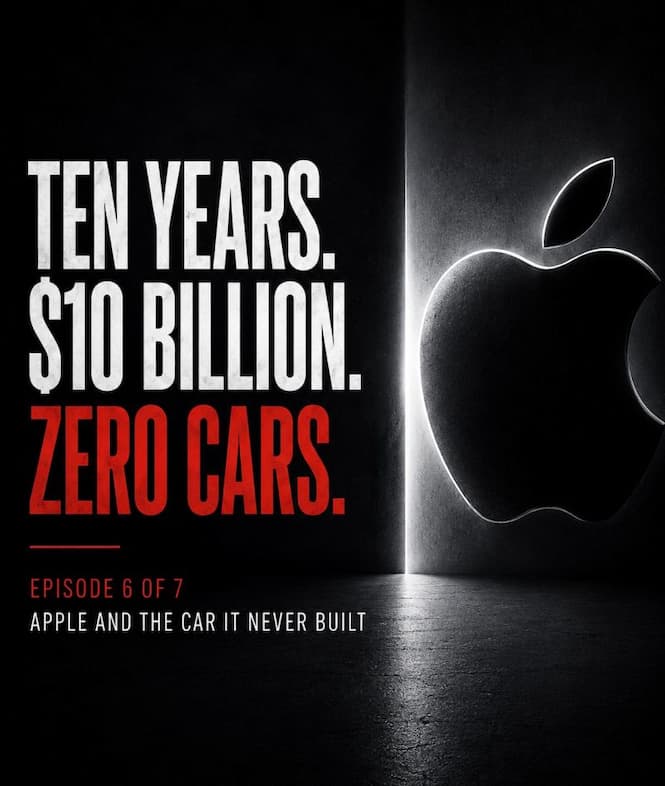
Apple spent a reported ten billion dollars and ten years trying to build an electric car. It never built one.
In February 2024 the most valuable company on earth quietly told the roughly 2,000 people still on the project that it was over. This is part six of my series on the biggest EV failures of the last decade, and it should humble anyone who thinks money and talent are all it takes.
Apple had everything the failed startups in this series lacked. Near unlimited cash, the best supply chain operation in the world, and its pick of talent. It poached executives from Tesla, BMW, Lamborghini, and Ford, and even hired people away from the EV startups that were going under. One of those hires had run BMW’s i3 program before a stint at Canoo, the company that opened this series.
The car was meant to be Apple’s next great business, a new source of revenue as its hardware sales plateaued. If any company could brute force its way into building cars, it was this one.
So what went wrong? Apple could never decide what it was building. For a decade the project swung between a fully self driving pod with no steering wheel and a more ordinary electric car, and back again. Leaders cycled in and out, one of them a former Tesla executive who ran the project and then left for Ford. The launch date slid from 2019 to 2024 to 2025 and finally to 2028, each delay paired with a smaller ambition, until the plan had shrunk from a robotaxi to little more than a driver assistance feature.
There was a harder problem underneath. Apple builds objects that fit in your hand at margins near 40 percent. A car is 2+ tons of steel, safety law, and dealer networks, sold at margins that would embarrass any Apple product. Apple could design a gorgeous car. Manufacturing one at a price that made sense was another matter, and after talks with Hyundai, Kia, and others, it never found a partner to do it.
In the end Apple did what the other companies in this series did when they quit. It sold the pieces. Its 5,500 acre car proving ground in Arizona went to Waymo , recovering about 220 million dollars of the roughly ten billion it had spent. The engineers were redirected to artificial intelligence. Ten years of work produced no car, only a very expensive lesson.
Here is the lesson, and it is a humbling one. Apple had more money than anyone and its pick of the world’s engineers. The thing it could never assemble was agreement, a clear and steady answer to what it was building, held together long enough to ship. That is the piece that decides car programs, and the richest company on earth spent a decade proving it could not buy that piece off the shelf.
Next week, the finale, billions committed to a national charging network, four years gone, and almost nothing on the ground to show for it.
Why didn’t Apple succeed?
Several factors made the project extraordinarily difficult:
- Building cars is far more capital-intensive than building consumer electronics.
- Autonomous driving proved much harder than expected.
- Profit margins in the auto industry are much lower than Apple’s traditional businesses.
- The market became increasingly competitive as Tesla, Inc. and Chinese manufacturers such as BYD Company gained scale.
- Apple could not identify a product that met its standards for both innovation and profitability.
Ironically, while Apple abandoned the project, many of the technologies it developed—AI, machine learning, batteries, sensors, and silicon—continue to benefit products such as the iPhone, Apple Watch, and Apple’s broader AI efforts.
Yes. Steve Jobs was involved in the very earliest thinking about an Apple car, but he died long before the project became a serious engineering effort.
Here’s the timeline:
- 2008–2010: As Apple was becoming enormously successful with the iPhone, Jobs reportedly asked a small group of executives to explore whether Apple should build a car. The idea was only in the exploratory stage. Several former Apple executives have said Jobs believed the automobile industry would eventually be transformed by software, batteries, and user experience.
- October 2011: Jobs died. At this point there was no formal Apple car program.
- 2014: Under Tim Cook, Apple officially launched the secretive Project Titan, hiring hundreds of automotive engineers from companies such as Tesla, Inc., Ford Motor Company, and General Motors. The original vision was reportedly a fully autonomous electric vehicle.
- 2015–2023: The project went through numerous leadership changes, strategy shifts, and layoffs. Apple alternated between pursuing a complete vehicle and focusing more on autonomous-driving technology.
- 2024: Apple reportedly canceled the EV project after investing billions of dollars and more than a decade of work. Many employees were reassigned to Apple’s AI initiatives. The company never publicly announced the car project, but its cancellation was widely reported. Bloomberg, among others, reported the shutdown. Apple Inc. never released an Apple-branded automobile.