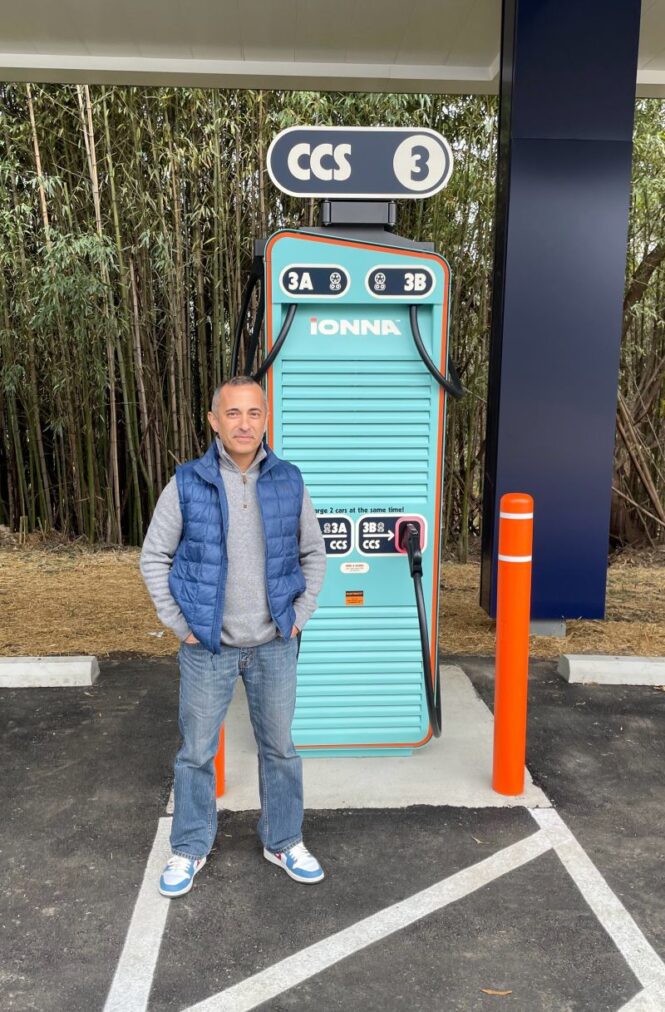
EV Charging 2025 Update
In 2025, the EV charging station industry moved from rapid experimentation into large-scale execution. Major automakers, utilities, and charging-network operators accelerated deployments of high-power fast chargers, standardized connectors, and corridor-based infrastructure aimed at both consumers and fleets. The year was marked by landmark rollouts tied to government funding programs, deeper OEM-to-infrastructure partnerships, and the continued consolidation around common charging standards. At the same time, the industry faced real-world constraints—grid capacity, permitting delays, and uneven regional adoption—signaling a shift from headline growth to disciplined, infrastructure-grade deployment. Together, these developments positioned EV charging in 2025 as a maturing backbone of the global electric-mobility ecosystem rather than an emerging add-on.
In News
- Walmart Launching EV Chargers
- Datacap Launches PayLoader™: A Multi-OEM Terminal Management System for POS, Kiosks, and Unattended Payment Devices
- Tesla Kiosk Centralized in Trials – EV Charging
- EV Charging ANSI Standards Panel (EVSP) – Kiosk Industry
- EV Charging Infrastructure for Healthcare Providers – LG
- EV Charging Regulations
Opinion form LinkedIn

This year was not kind to EV charging. It was a market correction, and the industry felt it everywhere, budgets tightened, projects slowed, pricing pressure got uglier, and a lot of businesses went from “growth story” to “prove it” overnight.
In the U.S., NEVI policy turbulence did real damage to momentum because FHWA rescinded prior NEVI guidance and suspended state plan approvals on February 6, 2025, which paused new obligations until updated guidance and new plans were in place.
We also watched major players cut back or walk away.
Siemens announced significant job reductions including about 450 roles in its EV charging business, pointing to market conditions and competitive pressure.
LG Electronics decided to dissolve its EV charger division in spring 2025, citing demand softness and price competition.
Even Shell quietly reset expectations. In 2025, Shell moved to sell off a substantial portion of its U.S. Volta charging network, with the assets transferring to JOLT, and at the same time exited the North American third-party charging software market by shutting down Shell Sky support.
Part 2 is the part that matters, because despite all of this, the industry kept building.
If you only followed headlines, 2025 probably looked like EV charging “slowing down.”
If you lived inside the industry, it felt very different. 2025 was a hard maturity test.
Capital got disciplined. Tolerance for poor uptime vanished. And the market stopped rewarding promises and started rewarding outcomes that are unsexy but essential, chargers that work day after day, software that does not crash at 2am, field service that actually shows up, and projects that still make sense once you stress-test the economics.
For me, the year started on a personal low note. The end of 2024 was bittersweet. EVBox shut down operations in the US, closing a chapter that mattered to me. It was tough. But it also gave me the chance to work alongside some exceptional people. Engineers, operators, commercial leaders who genuinely cared about doing this right. That experience reinforced something important for me: the talent in this industry is not the problem. Execution and alignment are.
Policy uncertainty did not help. Early 2025 brought real hesitation across the US charging market. NEVI guidance was effectively paused for months. That was not abstract policy noise. It created real risk for developers, utilities, OEMs, contractors, and site hosts who depend on predictable timelines and capital flows. When updated guidance finally arrived late in the summer, a lot of momentum had already been lost.
What impressed me was how much of the industry kept moving anyway.
Operators tightened maintenance regimes and started treating uptime as a product, not a reporting metric. Site hosts became far more educated about power constraints and interconnection realities. Fleets kept pushing forward because depot charging economics are based on math, not headlines.
The fundamentals did not change. Efficiency still matters. Reliability still matters. Safety still deserves facts instead of fear. Standards and response frameworks are getting sharper as scale increases.
Yes, 2025 thinned the field. Some business models did not survive contact with reality. But it strengthened the core.
The teams focused on reliability, service, grid realism, and unit economics are the ones carrying this forward.
What I expect in 2026:
• Operations-first winners who treat uptime as part of the experience
• Faster momentum toward fleets, corridors, and high-utilization sites
• Better alignment between hardware, software, and service
• Fewer announcements, more outcomes
I still love this industry because it is being built in real time by smart, stubborn people who keep showing up.
That is why I am optimistic about 2026.
Major 2025 EV Charging Industry Highlights


California Energy Commission

Gasgoo

The EV Report

ABS-CBN

The Verge
-
EVgo deployed a significant share of its DC fast chargers with prefabricated modular skids, speeding installations and lowering costs across the network. EV Charging Stations With Tom Moloughney
-
Co-branded 350 kW fast-charging stations by EVgo and Toyota opened in early 2025, enhancing fast-charging access on major routes. EVgo
🌍 International and Regional Scale-Ups
-
V-Green announced deployment of ~63,000 EV charging ports in Indonesia by end of 2025, expanding Asia-Pacific infrastructure. electrive.com
-
VinFast partnered with CarBEV to roll out 5,000 charging ports in the Philippines starting in 2026, signaling EV ecosystem build-up in Southeast Asia. ABS-CBN
-
Wallbox partnered with Codale Electric to accelerate EV charging deployments in the U.S. Mountain West (UT, ID, WY, NV). The EV Report
🚗 Emerging Corridor & Fleet Charging Initiatives
-
In the U.S., new fast-charging stations opened along long-distance and rural corridors, improving EV travel confidence (e.g., Washington’s first NEVI-funded fast charger near North Cascades). Washington State Department of Commerce
-
Commercial and heavy-duty charging corridors like Greenlane’s I-15 between LA and Las Vegas advanced corridor-based deployments for freight and fleet electrification in 2025. Wikipedia
🤝 Strategic Partnerships & Industry Alignment
🔌 Cross-Brand Standards Adoption
-
The Tesla NACS charging standard continued its expansion, with multiple non-Tesla automakers and networks adopting or migrating to it — a major industry trend reshaping compatibility and network strategy in 2025. MotorTrend+1
🛠️ OEM & Infrastructure Collaborations
-
NIO Power and Zhong’an Energy launched 50 EV charging + battery swap stations across Anhui, China, marking strengthened energy ecosystem cooperation. Gasgoo
-
IONNA and traditional fuel-retailer partnerships (e.g., Wawa) hit thousands of contracted charging locations across the U.S., accelerating high-power network rollout by OEM-backed joint ventures. Wikipedia
📉 Challenges & Market Dynamics
⚠️ Deployment Slowdowns in Some Regions
-
UK EV charger rollout slowed significantly in 2025, with under-expected installation growth due to grid constraints, policy shifts, investment hesitancy, and regulatory changes. The Guardian
-
Some markets are reassessing expansion timelines as EV adoption growth moderates and investment priorities shift — indicating a more calibrated deployment phase globally. S&P Global
📊 Industry Reports & Market Trends
-
The Global EV charging station market is projected to reach ~$28 billion in 2025 with strong future growth toward 2032 (~15% CAGR). Yahoo Finance
-
Global public charging points saw more than ~1.3 million added in recent years, with EV charging infrastructure growth ~30 %+ year-over-year. IEA
-
Reports throughout 2025 highlighted smart charging, bidirectional charging (V2G), fleet-oriented infrastructure, and renewables integration as driving trends shaping network deployments and business models. Driivz
📅 Notable Industry Events
-
EV SUMMIT 2025 (UK) wrapped with key discussions on scaling infrastructure, policy, and market challenges across Europe. ElectricDrives
-
Multiple major conferences and summits across North America and globally provided forums for operator partnerships, tech deep dives, and regulatory dialogue aimed at accelerating EV charging adoption. AMPECO
Overall Industry Themes in 2025
✅ Rapid expansion of fast-charging infrastructure and modular deployment methods.
✅ Strong cross-industry partnerships, especially around standards and OEM collaborations.
✅ Growth in international networks from Europe to Southeast Asia.
⚠️ Select regional slowdowns highlighting grid and policy challenges.
📈 Evolving focus on smart grid integration, fleet electrification, and interoperability.
EV Charging RFP Trend
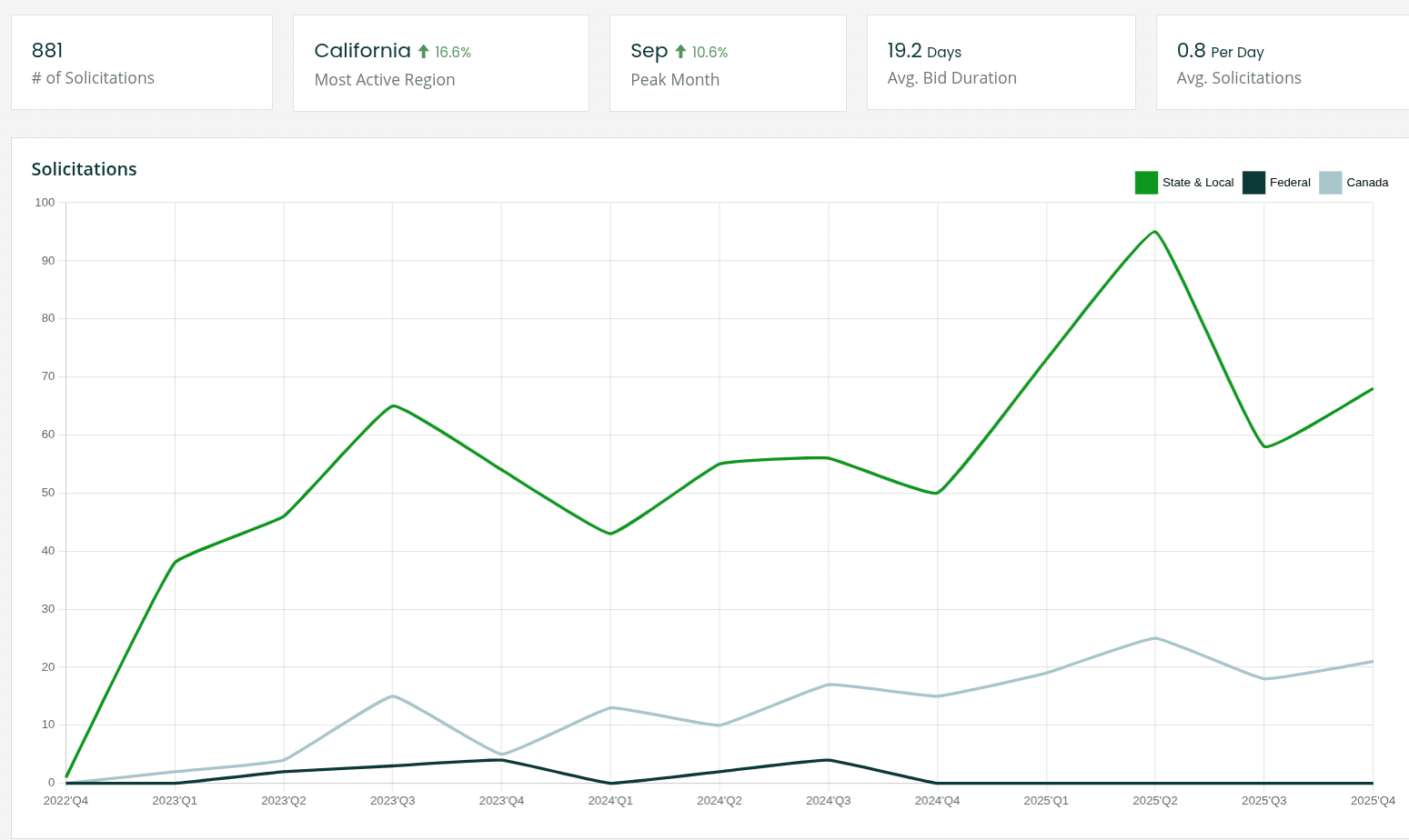
EV Charging Bids Last Three Years